Emily Greene Balch came from a noted Boston family of seven. Her grandfather founded Beverly, Massachusetts, where a house continues in the Balch name and is managed by the Beverly Historical Society.
Her father was a legislative official to William Sumner, the Massachusetts Senator who was almost beaten to death as an ardent abolitionist. In fact, many of Emily’s family members were abolitionists, surely informing her work for justice. Other influences in her early life included the Jamaica Plain Unitarian Church Minister Charles Dole, as well as non-religious persons to whom she felt connected. She advanced in many areas and had a particular love for poetry. In 1941, she published a book of poetry entitled The Miracle of Living.
Emily’s friend and biographer, Mercedes Randall, detailed her life in The Improper Bostonian: Emily Greene Balch, published in 1964. In the book, Randall writes that Emily exhibited an interest in peace at a young age. Her passion for peace led to her being called an internationalist and an “iconoclast” throughout her life.
Emily studied poverty alleviation policies at the Sorbonne University in Paris for a year but yearned to meet the people she studied. When she returned to the US in 1892 to join America’s “reform movement,” she co-founded the Women’s Trade Union League and founded Boston’s first settlement, the Denison House. She also became a close friend of Jane Addams, who had received the Nobel Prize for peace and social service.
During her time in Europe, Emily developed her teaching skills, which she later employed in her career at the University of Chicago, the University of Berlin, and Wellesley College. Her 22-year career at Wellesley began with a fortuitous meeting of the college president on a ship. After their conversation, the president asked her to teach economics there. She later taught other social sciences at Wellesley, and her courses were known for being interdisciplinary and rooted in her practical experiences, exploring politics, philosophy, sociology, and gender.
During her sabbatical in Austria-Hungary, Emily researched conditions in the Slavic neighborhoods and decided to become a socialist. Her book, Our Slavic Citizens, was unique for its time, as it presented firsthand views of immigrants and countered nativist racial assumptions. Her two major works on immigrants were studied in universities throughout the US. She was chair of the economics department from 1913 to 1918, until she was fired from her job against the will of the faculty for her leadership in peace activities and opposition to the First World War.
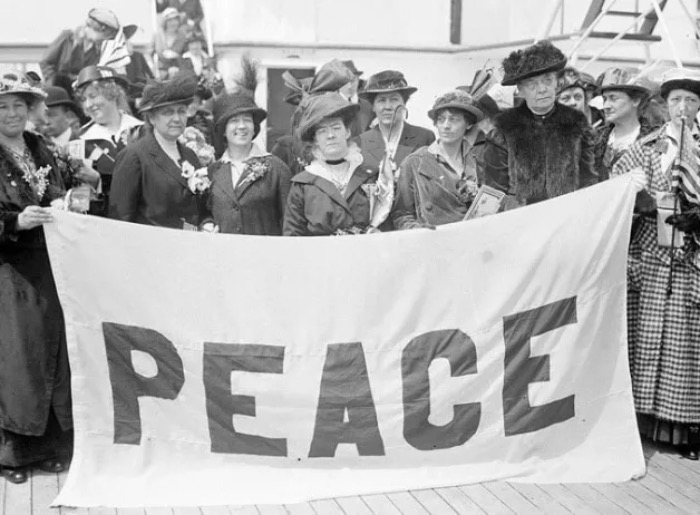
President Woodrow Wilson appointed Emily to the Ford Peace Mission in 1916, whom she advised to create the League of Nations. When this failed, she became an even stronger opponent of World War I. Alongside Jane Addams, Emily led the International Congress of Women (ICW) to the Hague to advocate for continuous mediation. She strongly opposed the 1919 Versailles Treaty, which the Chair of the Nobel Committee later noted as political wisdom on the matter. Emily lamented countries that could not attend the ICW—or were blocked from attending—such as Germany, Egypt, Palestine, and Cuba.
Between the two World Wars, Emily started summer schools for WILPF women and even taught there herself. After her work in the Hague, WILPF women from 14 countries continued to come together at ten conferences over the years, which she helped organize. Future conferences took place across Europe, including Zurich, Grenoble, Luhacovice, and Luxembourg.
Emily lectured about the Briand-Kellogg Pact, renouncing war and advocating for peace ratification throughout the US, giving life to the League of Nations in the fight against “defeated isolationism.” In 1922, during her stay in Geneva, she was particularly active in organizing conferences on questions of modern warfare, opium, the Austrian problems, and minority questions. Her influence was incalculable.
She repeatedly noted the need to look for an ethical foundation of peace—beyond the stated content of documents. She advocated for a moral conviction from parties involved in peace negotiations, especially Europe, Russia, and America. “International unity is not in itself a solution,” she said. “Unless this international unity has a moral quality, accepts the discipline of moral standards, and possesses the quality of humanity, it will not be the unity we are interested in.”
In 1926, she led a special mission for WILPF to Haiti to investigate conditions there. US Marines occupied the country, and Emily’s delegation recommended withdrawal. The government followed this recommendation and removed all troops. Her lengthy book on Haiti details the conditions at the time and includes interviews from her work there.
Emily was also the first to propose the “internationalization of Antarctica,” which became law for the area, deeming it would be used only for peaceful means and scientific research. In the 1930s, she advocated for the US to accept refugees fleeing Nazi Germany and helped relocate a number herself. Her book Refugees as Assets explains their benefits to society.
In 1936, she served as International Secretary and elected Honorary President of WILPF in Geneva and became a Quaker pacifist. Jane Addams was elected president and remained in that position until she died in 1935. Emily’s legacy is commemorated in part in her many books, including Our Slavic Citizens, Women at the Hague, Refugees as Assets, and Approaches to the Great Settlement.
Emily never ceased to work for peace and justice. At age 72, she began helping to relocate Japanese-Americans who were interned in concentration camps. Her legacy lives on in the actions of WILPFers throughout the years. Her words inspire us to courageously live up to our ideals and to work for peace and justice:
“Fascism and national socialism today can be destroyed only through means which are capable of impressing the brutal men of fascism and national socialism… We women pacifists have come to recognize this…without even becoming untrue to our pacifist convictions.”
“Those of us who are not Jews are oppressed by a sense of our own responsibility for we too are guilty. We are all answerable in part for the development of a state of things where the civilized world can find no better way out than competition in reciprocal slaughter and destruction. We were not ready in time with any other method than this slow and cruel one.” (written in 1942 to Rabbi Wise of the World Jewish Congress)
“We are not asked to subscribe to any utopia or to believe in a perfect world. We are asked to equip ourselves with courage, hope, and readiness for hard work and to cherish large and generous ideals.” (1946 Nobel speech)
You can learn more about the inspiring life and legacy of WILPF founder Emily Greene Balch in this video, “A Proper Bostonian: Emily Greene Balch Restored.” The video shows the commemoration of the 50th anniversary of Emily Greene Balch receiving the Nobel Peace Prize at Wellesley College. Wellesley College continues to honor Emily’s legacy through its Emily Greene Balch Internships, which have been awarded since 1997 through the college’s Peace and Justice Studies Program. Recipients of the award work for peace, justice, and social change in their communities.
