Love & Legacy: Pitru Paksha
“Love & Legacy” is an essay series exploring how cultures commemorate loss and death, turn mourning into celebration and legacy, and legacy into activism. We invite you to carry the legacy forward: honor someone special by donating in memoriam or making a bequest to WILPF US to sustain our work. Contact plannedgiving@wilpfus.org to learn about leaving a legacy at WILPF.
Pitru Paksha is a fifteen or sixteen-day period honored by Hindus, dedicated to the ancestors. Over 5,000 years old, Hinduism is the oldest religion on earth. It is a free-form religion and can be observed in many different ways. In Hinduism, the creator, Brahman, may take the form of one god or multiple entities. One may have heard of gods like Shiva, Vishnu, Lakshmi, or Ganesh, but these are all interpretations of facets of Brahman.
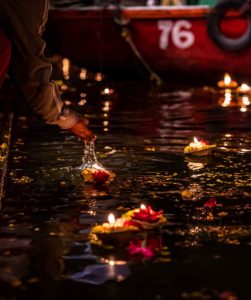
Pitru Paksha is a fifteen or sixteen-day period in which Hindus honor their ancestors. This year, Pitru Paksha will begin on Sept. 7. Photo by Raghav Rai Ralhan. Sourced from Creative Commons.
Additionally, Hindus recognize the Vedas as scripture. Veda means “knowledge,” and the texts are impossible to translate exactly. Instead, they are intended to be read and sung in Sanskrit. Hindus are not required to view the Vedas as strict doctrine, and some place more importance on spiritual experience instead of the written word or prefer certain deities over others. Those in close alignment with the Vedas are more likely to observe Pitru Paksha.
Pitru Paksha is the annual period to pray for and comfort the souls of the dead. During Pitru Paksha, the souls of the departed are believed to be closer to the plane of the living, so the 15-day period is a time for charity, gratitude, and expressions of love. There are a variety of ways to honor this time. Observers may offer food to Brahmins (priests), the poor, the unhoused, or sacred animals. Another common practice is the hosting of poojas, translated to “worship.” Poojas are ritualistic ceremonies where participants will sing, chant, create offerings, and pray to deities. Offerings from loved ones are said to increase the dharma, or righteousness, of the living. During Pitru Paksha, it is inauspicious to start projects, host events like weddings, or travel long distances.
Hindus believe that all life is sacred and all religions are to be respected. In addition, they believe in reincarnation and the laws of cause and effect, or karma. Therefore, souls go through birth after birth until karmas are resolved and spiritual knowledge is achieved with moksha, or nirvana. When a Hindu dies, the soul is said to leave the body and enter a new one after a year, leaving no purpose for the body. This is why cremation is very common in Hindu regions.
Hindus are superstitious about “good deaths” versus “bad ones,” separated by the preparedness of the family and the peace of the departed one or lack thereof. Generally, death is not considered good or bad. Typically, Hindus do not subscribe to life-extending processes because death is seen as an inevitable and acceptable part of life. Once a person has reached 90, death is no longer considered sad; it is a celebration of life and an acknowledgement that the soul is ready to move on.
Activist Legacies: Spotlight on Sarojini Naidu
Sarojini Chottopadhyaya was born in Hyderabad, India, on February 13, 1897, to a high caste family. She attended multiple colleges but did not complete her degree before returning to India. However, during her studies, Sarojini met literary figures like Arthur Symons and Sir Edmund Gosse. These interactions were her entry point into the world of poetry.
Flouting the norms of the caste system, she married Dr. Muthyala Govindrajulu Naidu in the early 1900s. Naidu and her husband had four children. Also during this time and despite unfair criticism from English male counterparts, Sarojini published immensely popular works like The Village Song and In the Bazaars of Hyderabad, infusing themes of justice and equality into her art. Naidu was always aware of the inequalities in Indian society, like the caste system, division of Bengali territory, expected subservience of women, and religious conflict between Hindus and Muslims.
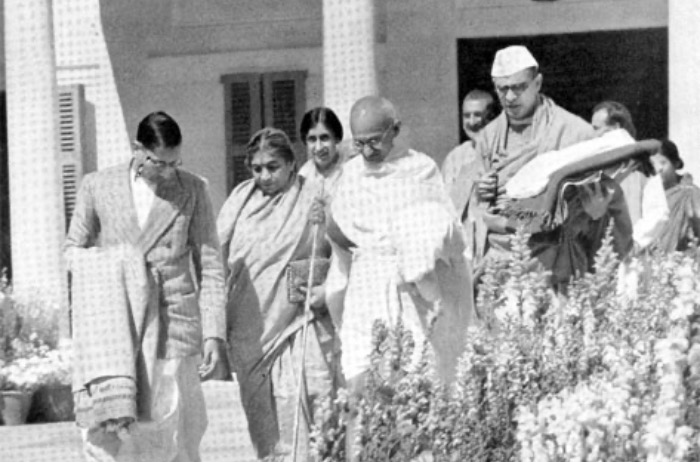
Sarojini Naidu with Gandhi. Public domain image.
Naidu’s activism and political career took off when she met freedom fighter Mahatma Gandhi in 1914. Women in positions of power were virtually unheard of, but Naidu defied all societal expectations. She was a brilliant orator and leader, inspiring crowds to the point that Gandhi put her in charge upon his arrest. In 1917, Naidu led a meeting with the Indian Secretary of State, the Governor General, and other women to criticize the prevalent discrimination against women.
Later, she helped establish the Women’s India Association and the All-India Women’s Conference. She became further entrenched in the political world, presiding over the Indian National Congress in 1925, the first woman to do so, and the All India Congress Committee in 1938. Eventually, she was appointed as the first governor of the freed United Provinces of Independent India in 1947. She served as governor until she died in 1949.
Naidu is a shining example of female leadership. Her political accolades alone make her revered, but she was able to balance her activism with family life and her art, demonstrating that she did not have to compromise on her values to achieve success.
Leaving a Legacy: Please Consider a Gift to WILPF
We hope these stories of legacy inspire you in its many forms. Please consider donating to WILPF US in memory of someone special, or make a personal bequest to sustain our work for generations to come. Contact plannedgiving@wilpfus.org.
Sources:
https://doi.org/10.1080/07481187.2010.518420
https://www.worldhistory.org/The_Vedas/
https://www.siddhayoga.org/pitru-paksha/about/
https://www.mkgandhi.org/Selected%20Letters/Sarojini/preface.php
https://digitalcommons.georgiasouthern.edu/cgi/viewcontent.cgi?article=1131&context=aujh
